|
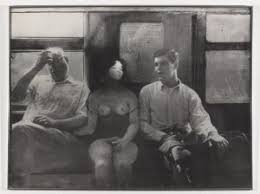
| In a Local Village Bar, Paula Horn Kotis, 1955 |
Paula Horn Kotis was a
photographer who chronicled the Greenwich Village bohemian scene in the 1940’s
and 1950’s and the turbulent aftermath of the birth of Israel in 1948 and 1949.
Kotis died in October 2013, in her early nineties. I had interviewed her at her residence in East Harlem in
January 2009. She told me about her wild Beat days in the Village, her
friendship with the writer James Baldwin and her work as the first in-house
photographer for the new Circle in the Square Theatre, located near Sheridan
Square in the Village. One of her gorgeous black-and-white images of a young
woman passed out in a Village bar is in the permanent collection of the Museum
of Modern Art.
Paula Horn Kotis moved to Cape Cod and gave up her photography career in the 1960s to raise a family. Kotis had two sons. Her son Greg Kotis is a playwright. He is most famous for writing the book for the musical "Urinetown."
Kotis gave me a clear-eyed and unsentimental view
of Greenwich Village’s last bohemian period and
the bar culture, where heavy drinking took its toll on her friends. An old boyfriend, the acclaimed cinematographer Dick Bailey, who shot "On the Bowery," died of liver disease in the early 1960's.
Here is our interview:
KOTIS: I was born in East Harlem. My father had a business of
properties. The neighborhood changed, so we moved to 95th and Madison.
My picture is on the cover of Jimmy Baldwin’s book, “Notes of a Native Son.”
The Museum of Modern Art bought one of my pictures… “In a Local Village Bar,” 1950s.
DF: How did you become a photographer?
My picture is on the cover of Jimmy Baldwin’s book, “Notes of a Native Son.”
The Museum of Modern Art bought one of my pictures… “In a Local Village Bar,” 1950s.
DF: How did you become a photographer?
KOTIS: My father had been an old-fashioned portrait photographer. He had a studio. As a retoucher, he was considered extremely gifted. Nobody had their portraits redone then without having them retouched. He opened a studio on 92nd and Madison. I had graduated from Hunter College and I had all these jobs I hated. I walked out of one of my last jobs. I couldn’t stand moving paper for other people.
I said, “Papa, can you teach me?” He said, “You can have the studio.” The big thing I did was no retouching. I did everything with lights. I used to work late at night in the darkroom because it was quiet. I could hear people on the street. I had a light on and my photos in the window, and people would say, “Who is that photographer?”
The first Village bar I went to was on 7th Avenue. It had jazz with a guy named Frankie Newton. He was a big fat guy. Frankie Newton was so ugly. He was there because he wanted white girls. A lot of black guys who came down heard that there were white liberal intellectuals girls. I hate to sound this way, but I am telling you the truth, including Mr. Poitier and Mr. Belafonte. This was later. They opened a soul food restaurant on 7th Avenue. What they really wanted to do was go to all the parties and pick up girls.
DF: What was Louis’ Tavern?
KOTIS: Louis’ Tavern was right next to the Circle and the Square. Louis’ was the place before the San Remo and the Minetta Tavern. Louis’ was a couple of steps down and was a dark and dirty place. Steve McQueen was a bartender there.
It was college girls and
bookkeepers, girls who had 9-to-5 jobs who would meet up with the artistes, who
were not only looking to get laid, but they were looking for
someone to support them. A lot of these guys…I was friendly with this vet named
Billy Caruthers. He was African-American. We got along great. He was the one
who told me Anatole was black.
There were also cafeterias. They were free. You could just sit there.
Weegee tried to make me. He was very ugly, a sloppy guy with a cigar. He took me to his bedroom, next to a police station. I was already taking pictures before I opened the studio.
We were looking for something. I didn’t want a bourgeois husband. There was a guy who was after me who was a shoulder-pad manufacturer. I said, “I’m not marrying a shoulder-pad manufacturer.” He was a boring, dull guy.
It was an exciting time, in a lot of ways, but a lot of people, particularly girls, got hurt. The guys, as a whole, were adolescents. They never grew up, they just grew older.
There were also cafeterias. They were free. You could just sit there.
Weegee tried to make me. He was very ugly, a sloppy guy with a cigar. He took me to his bedroom, next to a police station. I was already taking pictures before I opened the studio.
We were looking for something. I didn’t want a bourgeois husband. There was a guy who was after me who was a shoulder-pad manufacturer. I said, “I’m not marrying a shoulder-pad manufacturer.” He was a boring, dull guy.
It was an exciting time, in a lot of ways, but a lot of people, particularly girls, got hurt. The guys, as a whole, were adolescents. They never grew up, they just grew older.
I knew Anatole Broyard.
He was a horror. He was very handsome but I was never attracted to him. Very unprincipled.
I had an uptown, downtown life. I dressed very bohemian. I wore black turtlenecks and tight pants. At that time, I had a fabulous figure and I knew it and everybody else knew it. My whole life was pretty flamboyant.
DF: How did you wind up working as a photographer
in Israel?
KOTIS: I went to Israel because of a boyfriend, Dick Bagley, who was making a film there. It was the biggest mistake of my life. I left the studio. I didn’t want to do studio work. I wanted to emulate Henri Cartier Bresson. I went to Europe as a freelance photographer. They wouldn’t give me a visa. It was after the war. I flew from Rome to Tel Aviv. I was a photographer. The Israeli government wanted as much publicity as they could get. Every morning, I went to the public information office. I photographed kibbutzes. I came back to New York in 1949. The Village was getting expensive, so I moved to a place called Slaughterhouse Alley in the East Village, on 11th Street. I was starving. They were small apartments and communal showers. The toilet was shared. They were awful.
DF: Did you know Jack Kerouac?
KOTIS: I think he was the biggest fraud of all time. I was a beatnik, but I didn’t know I was a beatnik. It was a constant awareness of our mortality. I read the Russians--Tolstoy, Turgenev and Dostoevsky. I had a very grim outlook on life. I still do.
Most of the guys in the Village, they were totally irresponsible. A lot of women were hurt.
DF: Were you friendly with the painter Iris Brody?
KOTIS: I have three of her paintings. This was a beautiful painting [pointing to an Iris brody work on her wall]. It was done on rice paper. It is all faded. I wouldn’t have bought something with no color. Iris jumped off a roof. A lot of these girls were turned on to drugs. I was lucky. I found people who smoked pot. To me, it was so unhygienic, passing around a joint. As Beat as I was, I was always very clean.
DF: What was your social life like?
KOTIS: I went to Israel because of a boyfriend, Dick Bagley, who was making a film there. It was the biggest mistake of my life. I left the studio. I didn’t want to do studio work. I wanted to emulate Henri Cartier Bresson. I went to Europe as a freelance photographer. They wouldn’t give me a visa. It was after the war. I flew from Rome to Tel Aviv. I was a photographer. The Israeli government wanted as much publicity as they could get. Every morning, I went to the public information office. I photographed kibbutzes. I came back to New York in 1949. The Village was getting expensive, so I moved to a place called Slaughterhouse Alley in the East Village, on 11th Street. I was starving. They were small apartments and communal showers. The toilet was shared. They were awful.
DF: Did you know Jack Kerouac?
KOTIS: I think he was the biggest fraud of all time. I was a beatnik, but I didn’t know I was a beatnik. It was a constant awareness of our mortality. I read the Russians--Tolstoy, Turgenev and Dostoevsky. I had a very grim outlook on life. I still do.
Most of the guys in the Village, they were totally irresponsible. A lot of women were hurt.
DF: Were you friendly with the painter Iris Brody?
KOTIS: I have three of her paintings. This was a beautiful painting [pointing to an Iris brody work on her wall]. It was done on rice paper. It is all faded. I wouldn’t have bought something with no color. Iris jumped off a roof. A lot of these girls were turned on to drugs. I was lucky. I found people who smoked pot. To me, it was so unhygienic, passing around a joint. As Beat as I was, I was always very clean.
DF: What was your social life like?
KOTIS: The Minetta Tavern was important. Everyone was there. Anatole was a fixture. James Baldwin was a fixture. We shared a boyfriend at one point. We were going uptown from the Christopher Street Station together. He was very down. He said, “I’m ugly. I’m black and I’m gay. What else could happen to me?” “You could be Jewish,” I said. He thought that was hilarious. We got to be good friends. He could be very irresponsible. He never showed up on time.
Between the Minetta Tavern on MacDougal and the San Remo, There was the Carlboms, Marshall Carlbom…there was a constant party there.

(In the 1946, Kotis was painted by the quirky portrait painter Alice Neel, known for twisting her subjects. The portrait was titled "Dick Bagley's girlfriend," after her bisexual, alcoholic cinematographer boyfriend. This painting sold at auction in the fall of 2025 for more than half a million dollars.)
DF: What was the San Remo Cafe like?
KOTIS: Norman Mailer came in all the time, and Gore Vidal.
It was a huge place. You could sit there and nurse a beer for god knows how long. It was hectic. It was always packed.
I finally moved myself out of the Village. I moved to Chelsea. I would see some of the older characters in the Village and thought, am I going to become like that?
I photographed for the Circle in the Square.
My husband was Stanley Kotis. We married in 1957. Passed away in 1983.
It was a huge place. You could sit there and nurse a beer for god knows how long. It was hectic. It was always packed.
I finally moved myself out of the Village. I moved to Chelsea. I would see some of the older characters in the Village and thought, am I going to become like that?
I photographed for the Circle in the Square.
My husband was Stanley Kotis. We married in 1957. Passed away in 1983.